Explore how Link can help you assess, prioritize, and reduce your company's impacts and risks related to nature.
By submitting this form you agree to be contacted by Link Nature. To opt-out of communications, please click the unsubscribe link in our emails.
Thank you! Your submission has been received!
Oops! Something went wrong while submitting the form.
October 30, 2025
Part 10: The Solution Isn't More Data. It's Better Engagement.
Josine oude Lohuis
This interview is part of 𝐅𝐨𝐥𝐥𝐨𝐰 𝐭𝐡𝐞 𝐇𝐨𝐧𝐞𝐲, weekly interviews with fresh takes on biodiversity in business.
The corporate sustainability world is not short on knowledge. There are thousands of pages of guidance, hundreds of frameworks, and dozens of new reporting standards. Yet, for many companies, the journey from ambition to action is painfully slow. Why?
To answer that question, I sat down with Nadine McCormick, a 20-year veteran of the sustainability space and a key figure on nature action at the World Business Council for Sustainable Development (WBCSD). Over her career, she has evolved from a “translator” between science and business to a change agent focused on a simple, powerful truth: the biggest barriers to progress aren't technical, they're human.
We discussed why the most effective tools for change are not thicker reports but smaller peer groups, how to reframe nature in a language that resonates, and her crucial advice for breaking through the cognitive overload that paralyzes so many organizations.
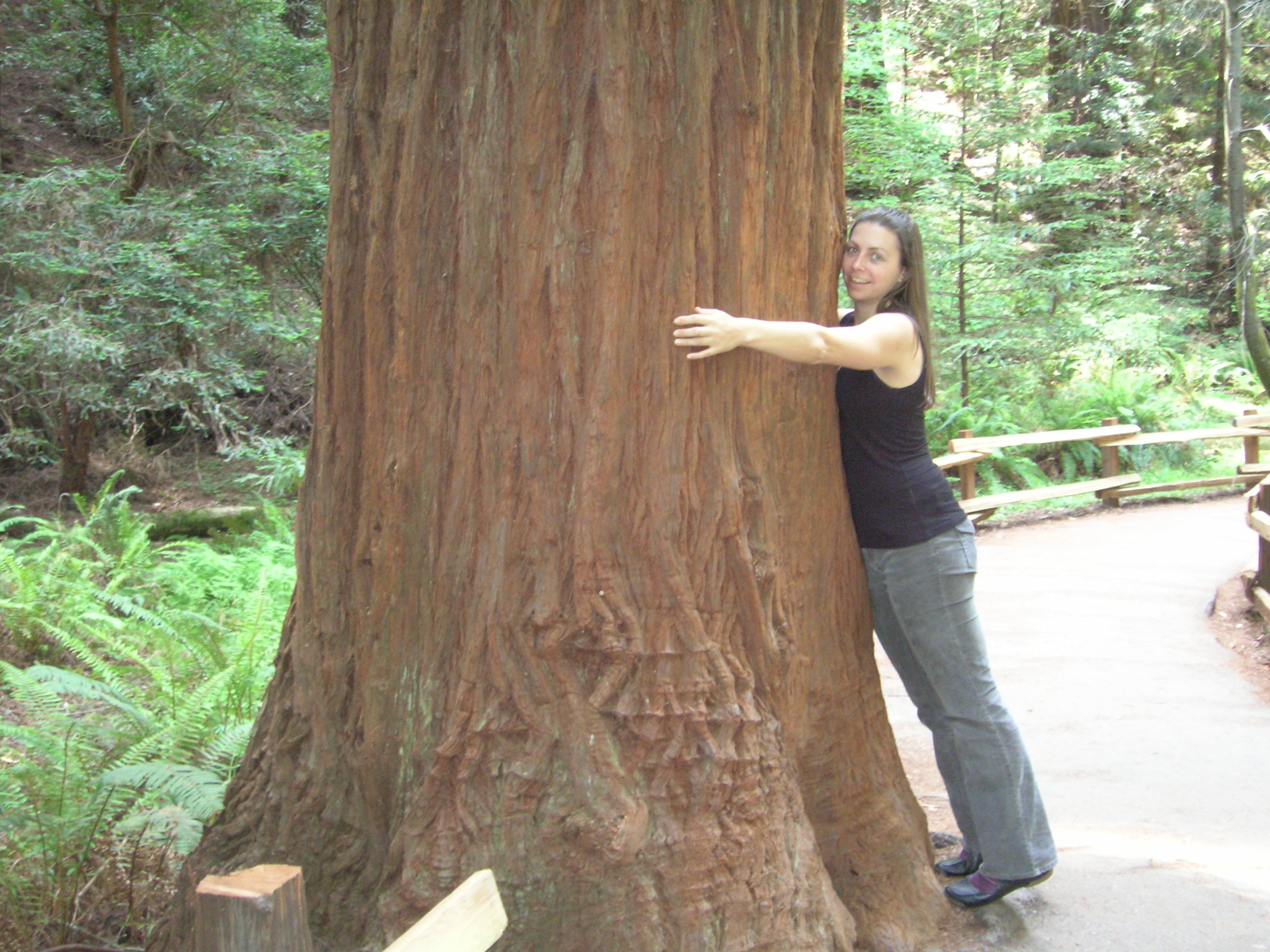
An adult arm circumference is equivalent to about 50 years for an “average” tree. Nadine loves arranging groups of people to see how many it takes to get around a very old tree!
You’ve been in this space for two decades, between deep nature experts and business leaders. What’s the biggest shift you’ve seen?
The journey has been one of constant learning. We’ve gone from developing the early natural capital protocols to now grappling with a global goal for nature. In March 2021 when I joined WBSCD, my first task was to review a paper on “Nature Positive,” the equivalent of “Net Zero” for nature. The draft had just one, generic paragraph on the role of business. It was clear more was needed. That moment sparked a multi-stakeholder process to define what this new goal really means in practice, leading to the creation of the WBSCD “Roadmaps to Nature Positive”, and inspiring similar initiatives. What’s become clear over twenty years is that you can’t just write a guide and expect change. You have to bring people along on the journey.
That goal, “Nature Positive,” is meant to be a simple North Star. From a communication standpoint, why is that simplicity so important?
Because at the end of the day, when it comes to changing systems, it’s about human beings making decisions. A CEO can understand, “We need more nature in 2030 than we had in 2020.” “Nature positive” is a vision, a direction of travel. Of course, the devil is in the detail, and the experts will rightly ask about baselines and metrics, but that simple, high-level goal is the crucial starting point.
What’s become clear over twenty years is that you can’t just write a guide and expect change. You have to bring people along on the journey.
That simplicity also seems to create confusion. I hear people using terms like 'biodiversity' and 'nature' interchangeably. Do you see this as a barrier to progress?
Not at all. It's a sign that new people are entering the conversation. That confusion is an opportunity to engage, not a reason to get frustrated. When someone asks, “Wait, I thought we were talking about biodiversity. Now it’s nature? Aren’t they the same?” it opens the door. It's a crucial entry point to start where they are and explain the relationship: that nature is the whole system of the natural world, and biodiversity is a measure of its health.
We must recognize that success isn't just getting 300 people on a webinar; that's merely a stepping stone.
What do you see as the biggest barriers for corporate nature action?
The perceived barriers depend on where the individual is on their nature journey. However, in general, we have a cognitive overload problem. We keep producing more and more guidance, but our problem isn't a lack of information; it’s the human capacity to navigate it. I’ve run anonymous polls on calls to discuss 200-page document from a partner organizsation. The most common answer? “I opened it, saw how long it was, and immediately closed it again.” The current approach of providing massive, one-size-fits-all documents is paralyzing.
We must recognize that success isn't just getting 300 people on a webinar; that's merely a stepping stone. True success is when a company takes credible action to halt and reverse nature loss. This action must be informed by a robust plan that assesses material issues, sets clear targets, and addresses the company's full impacts and dependencies on nature. We need to keep our eyes on the prize.
So if overwhelming people with data doesn’t work, what does? What have you found to be truly effective in driving change?
First, sector-specific guidance. We worked with Business for Nature and the World Economic Forum to develop two-page summaries of the typical nature issues for fifteen different sectors. It does the hard work for them. Instead of a company having to do a complex screening from scratch, it gives them a trusted, credible starting point for the conversation.
Second, targeted engagement based on maturity. You can’t push a company to shift its entire business model when they’re still asking if nature is even material to their business. We need to meet them where they are and provide the specific next three steps for them, not a list of forty.
Finally, cohort-based learning. We set up small groups of companies to work on the same challenge together, like preparing a TNFD LEAP assessment or building a nature strategy. It reduces the feeling of isolation and creates peer accountability. I once ran a workshop for an energy company, and the biggest win wasn’t the policy we wrote; it was connecting the sustainability professionals from different countries who all thought they were struggling with this alone. That shared experience provides crucial validation and opens the door to collaborative problem-solving.
There’s a lot of concern in the corporate world about the scalability and practicality of frameworks like the Science-Based Targets for Nature (SBTN). What’s your pragmatic take on this?
SBTN’s steps 1 and 2 related to assessing and prioritizing impacts is useful for all businesses to have external validation of their materiality assessments. However, step 3 on target setting is not currently applicable for all companies. Setting targets requires a differentiated approach based on level of maturity and business model. A business with a direct footprint on nature has a different role than one with a very complex, distant supply chain. A typical member company of ours might have 220 operations around the world, but only 20 of those might be in water-scarce landscapes that require a science-based target. A company’s strategy will include a mix of different goals and targets at different levels. A great example is GSK; they now have several validated science-based targets for nature, but these are part of a much broader suite of environmental targets.
That’s a crucial clarification. If SBTN’s approach focuses on targeting-setting in critical “hotspots,” how can a company address its impacts outside these landscapes and watersheds?
That’s exactly why we have to see the target as a means to an end, not the end itself. Companies need to develop strategies and transition plans to address negative impacts, invest in nature and transform systems, with targets at different scopes in the business. The levels can become more granular as data improves. The strategy needs to be developed with the relevant functional teams, including site managers, procurement, finance. Even R&D has a role to play. To have the greatest chance of successful implementation, each audience requires a targeted engagement approach, in a language that resonates with the team and targets that have been developed with their input. This is the focus of a joint Horizon-funded project A-Track, where we are helping nature leads to “Embed Nature” into their companies.
The most powerful reframes I’ve heard is this: Nature is the biggest supplier to your company that has never sent an invoice. Suddenly, that supplier is becoming less reliable, and there’s no one else you can switch to.
Looking at the big picture, you've said the sustainability community has a communications problem. How should we be reframing this conversation to be more effective?
We need to learn from marketers. They don’t sell a car; they sell security and status. We shouldn’t be trying to sell sustainability. We need to sell the outcome. What will a company have by taking action? What will they feel? We should be talking about long-term business and societal resilience.
One of the most powerful reframes I’ve heard is this: “Nature is the biggest supplier to your company that has never sent an invoice. Suddenly, that supplier is becoming less reliable, and there’s no one else you can switch to.” That’s a language of risk and dependency that resonates. You meet people with the language they understand, and you can introduce the technical concepts later once you have their attention. The trick is to give enough information to “hook” and not overwhelm. Not everyone needs to know what biodiversity is or how many disclosure frameworks are out there, just what they need to do next, why and how.
We use cookies to improve your experience on our site and to understand where our audience is coming from. To find out more, please read our Privacy Policy. By choosing I Accept, you consent to our use of cookies.