Explore how Link can help you assess, prioritize, and reduce your company's impacts and risks related to nature.
By submitting this form you agree to be contacted by Link Nature. To opt-out of communications, please click the unsubscribe link in our emails.
Thank you! Your submission has been received!
Oops! Something went wrong while submitting the form.
October 16, 2025
Part 8: Customers Don't Care About Your Footprint. But Your Future Business Does..
Josine oude Lohuis
This interview is part of 𝐅𝐨𝐥𝐥𝐨𝐰 𝐭𝐡𝐞 𝐇𝐨𝐧𝐞𝐲, weekly interviews with fresh takes on biodiversity in business.
Everyday products, from clothing to food, contribute to over one-third of global greenhouse gas emissions and more than 70% of biodiversity loss in critical regions. For the companies that make these products, this impact isn’t found in their office buildings; it’s embedded in the things they sell. The materials and the production process. This creates a challenge: to reduce their footprint, they must change their products, and to do that, they must convince their customers to come along.
Benjamin Vogel has dedicated his career to just this challenge. He is founder of Nayture, a consultancy that helps brands reach a mainstream audience with sustainable products. We explored why sustainability as a marketing message frequently fails, how an ROI-centric approach can motivate late adopters, and Benjamin offered practical advice on internal sustainability communication.
Your mission is to help companies reach a mainstream audience with more sustainable products. What’s so hard about that?
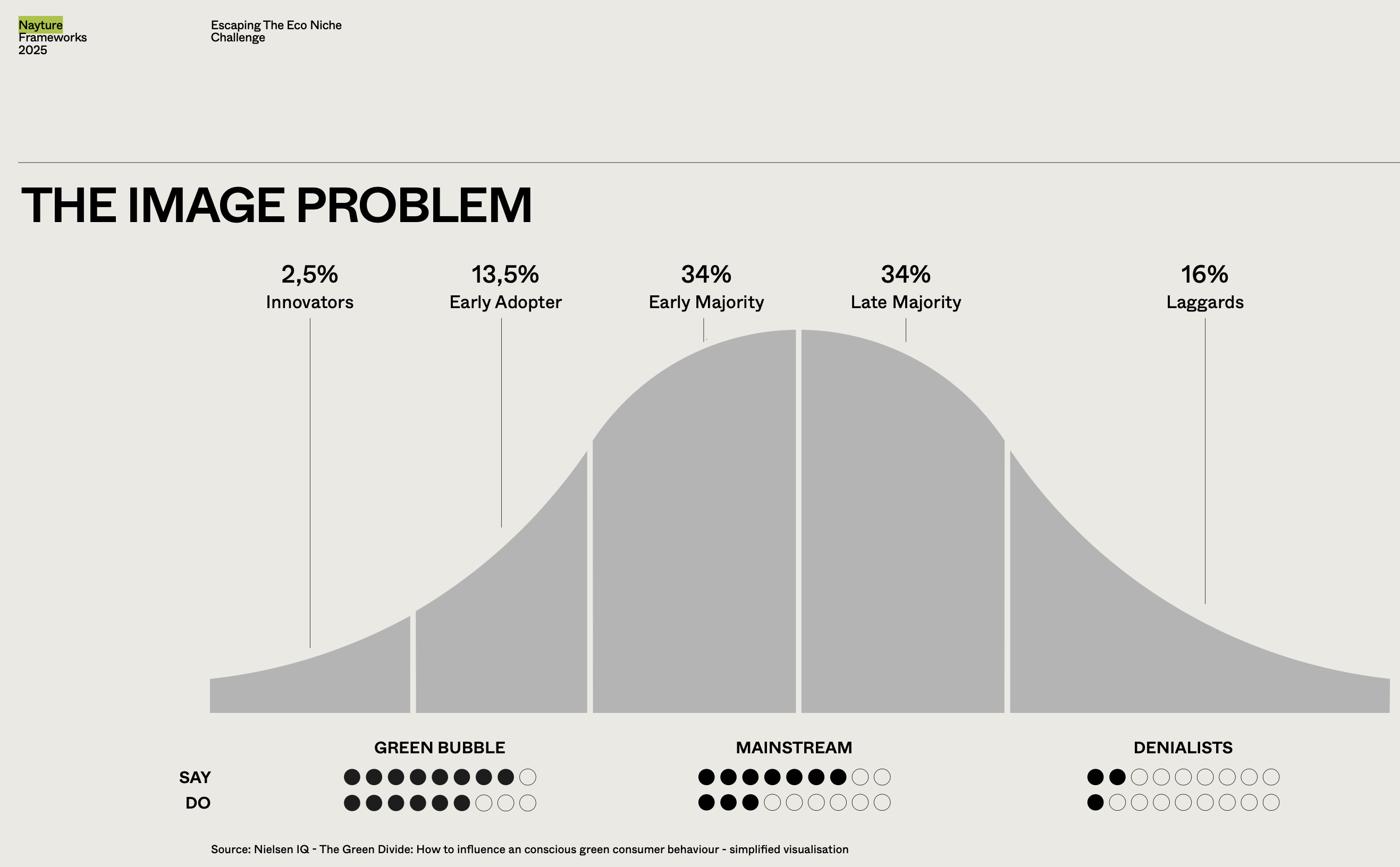
What makes it so difficult is that the vast majority of consumers operate on a completely different set of motivations than the small 'green bubble' of early adopters. You can think of the market in three parts: there’s a small group of innovators who genuinely want sustainable products and act on it. But then you have the 60-70% mainstream majority that does not decide what to buy based on sustainability insights. The core challenge is that companies have been trying to talk to this majority using a language that only the first group understands. The real difficulty is giving companies the tools to speak to the mainstream on their own terms.
What do companies do wrong when trying to reach them?
They use the wrong language. We have a simple "readiness test": can you explain your product without using green vocabulary like ‘carbon neutral,’ ‘circularity,’ ‘eco,’ or even ‘sustainability’? If you can't, you'll struggle. Patagonia is a great example. They don't sell "sustainable jackets"; they sell "high-quality jackets." The organic, toxic-free materials are secondary proof points, not the headline. The word ‘sustainability’ itself now has a boring, or even negative, connotation in many contexts.
But how do you know people aren't still buying Patagonia products because of their sustainable reputation?
Patagonia’s customer base is quite diverse. Politically, it includes both Democrats and Republicans. Scott Galloway captured it in a great way. A few years ago, he coined the term ‘Patagonia Vest Recession’ to describe the wave of tech layoffs in Silicon Valley, where many employees wore the iconic Patagonia vest. This example perfectly illustrates the point: this group isn’t buying because of Patagonia’s vocal environmental mission. They’re buying because they see Patagonia as a traditional American company that makes high-quality, durable products.
So if companies invest in reducing their product’s impact, which costs money, how can they justify a higher price if they don't communicate that value?
You can't convince people to pay more; you have to attract them. The justification for a premium is almost always the brand itself. A strong brand is a white card to ask for more. People pay a premium for a Mercedes-Benz because of its perceived quality and prestige, not because of a sustainability checklist. Building that brand takes a very long time; it took Patagonia fifty years. For most companies, trying to justify a premium by explaining the sustainable features simply doesn't work.
People buy things for only two reasons: to move closer to pleasure or to move away from pain. Sustainability doesn't fit either category for an individual.
Why is sustainability such an ineffective marketing message for the mainstream?
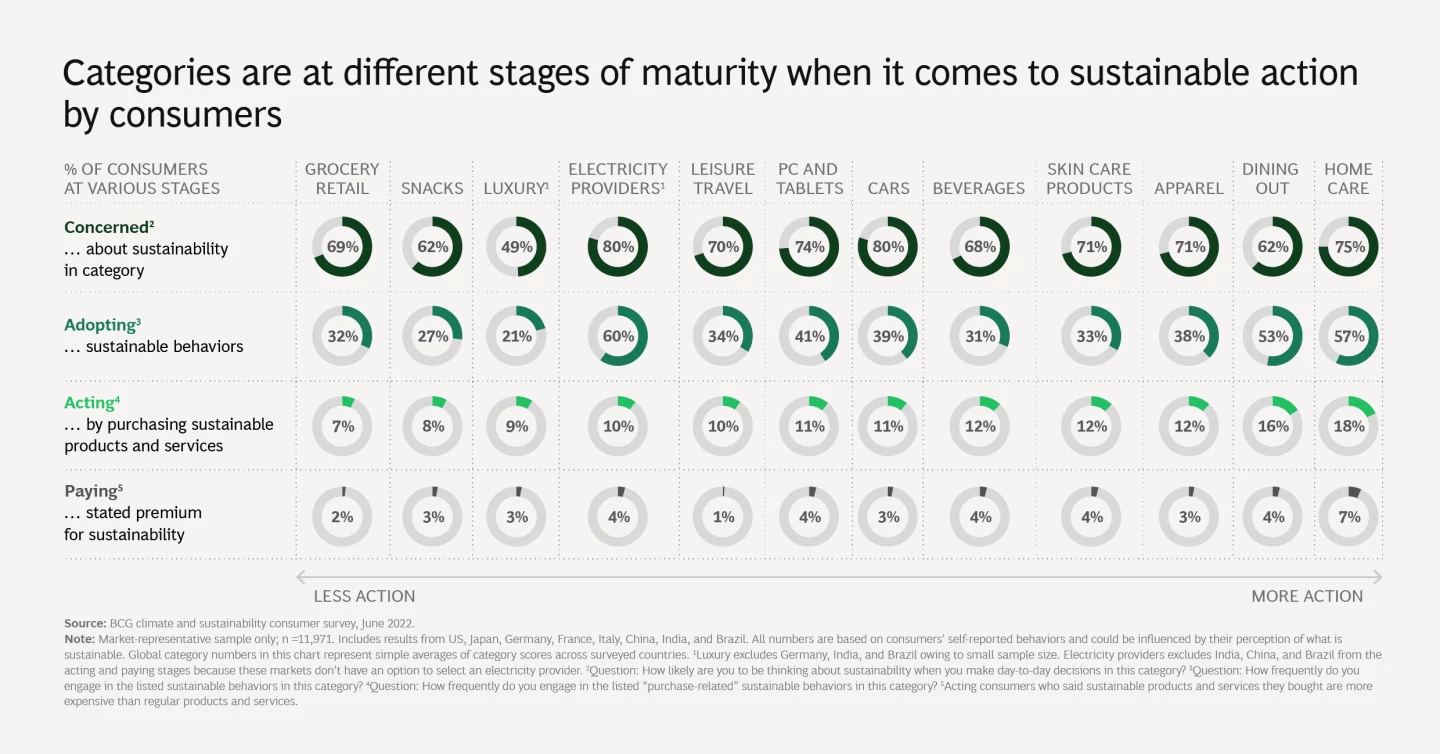
Because on the most universal level, people buy things for only two reasons: to move closer to pleasure or to move away from pain. Sustainability doesn't fit either category for an individual. It’s about helping our planet survive, which is a common good, not a personal benefit. A study from BCG highlights this gap perfectly. Across all retail categories, you see the same pattern: around 69% of people are concerned about sustainability, but only 7% are actively purchasing sustainable products, and a tiny 2% are willing to pay more. That's why sustainability shouldn't be in your top-level advertising.
That feels contradictory. Almost every major brand now has a prominent sustainability page on their website. Why is that, if it's not a sales driver?
That’s a different level of communication. Those pages serve as a "hygiene factor." If a journalist or a critical stakeholder is looking into your supply chain and can't find anything, it looks fishy. So, this communication is about transparency and de-risking your reputation for a very specific audience that is already looking for it. It's not a tool to sell more products to the mainstream.
On, a shoe company, [...] made a big, uncertain R&D bet that paid off for performance, brand, and sustainability, without ever having to label it a "sustainable product."
So you’re saying that companies should make sustainable products because they need to be a responsible brand, but then not communicate about it in their marketing?
Exactly. The innovation should speak for itself in terms that the mainstream understands, like performance, design, or convenience. Look at the ‘Light Spray’ shoe from On. They invested millions in developing a shoe that is sprayed onto an athlete’s foot, resulting in a product that is lighter, faster, and feels like a second skin. Consumers love it for the performance, not because it’s ‘green.’ They pay a 100% premium for it, and it’s always sold out.
But behind the scenes, that shoe has 75% lower carbon emissions and is made of a single component instead of the usual 15, making it far easier to recycle. That didn’t happen by accident. It happened because the company was already deep into the mindset of circularity. They made a big, uncertain R&D bet that paid off for performance, brand, and sustainability, without ever having to label it a "sustainable product."
Now let's talk about communication inside companies. You advocate for using a clear Return on Investment (ROI) model to get projects approved. Can you tell me a bit more about that?
We developed a scorecard that scores potential initiatives on two axes: their return on investment and their potential for impact. The ROI score is based on factors like expected cost savings, the investment required, payback period, and data accuracy. We then do the same for impact. A project that scores highly on both becomes a clear priority. For example, for a toothpaste company, we calculated that a packaging efficiency improvement had a payback period of less than two months and an annual ROI of over $2 million. That’s a language everyone understands.
But some argue this focus on efficiency can be a trap. A company might improve its per-unit efficiency, but if total sales grow faster, its absolute impact still gets worse. How do you address that?
You are totally right. But for the majority of companies, the alternative to an ROI-justified project is often doing nothing at all. The model serves as that essential foot in the door to get them moving. I need it for the two larger groups of companies: those doing the bare minimum for compliance, and those focused on stakeholder satisfaction. For them, efficiency projects are a no-brainer that gets the conversation started. But I don't need an ROI model to convince a company like Patagonia that is already deeply committed.
The goal is to use those initial wins to build the case for bigger, more systemic changes. The ROI is the internal tool to get traction and budget. The ultimate measure of success, however, must always be the company's overall impact, which should be transparent in their impact report.
Identify what makes your company tick. Design? Engineering prowess? Link your sustainability initiatives directly to that language. That’s how you get things done.
So if the ROI model is just a starting point, what is the single most important piece of advice for a sustainability professional trying to get real buy-in?
You have to link sustainability to the company's unique culture. The dog has to like the dog's food. For a design-driven company, we created a beautifully designed document called "The Anatomy of a Sustainable Shoe" that product designers loved. For a finance-driven company, we use the ROI Matrix, because that is what they know well.
You have to first identify what makes your company tick. What gets people excited? Is it design? Engineering prowess? Financial performance? Storytelling? Once you know that, you link your sustainability initiatives directly to that language. That’s how you get things done.
That final point on contextualization really resonates with me, as we are building an AI tool to do just that. From your perspective, what are the essential requirements for a system designed to help companies translate sustainability data into culturally-relevant business cases?
That’s a fascinating challenge. For a system like that to work, it would need to do two things exceptionally well. First, it must be able to codify expert knowledge on how to calculate and frame a return on investment. The quantitative business case is the foundation. But second, and more importantly, it would need deep context on the company itself. An AI would have to understand the company's goals, its policies, and its unwritten cultural rules to be effective. The real value wouldn't be in the calculation, but in the translation. Its success would depend entirely on its ability to help a user build a case that is not only quantitatively robust but is also framed in a way that truly resonates with the specific culture of their organization.
We use cookies to improve your experience on our site and to understand where our audience is coming from. To find out more, please read our Privacy Policy. By choosing I Accept, you consent to our use of cookies.