Explore how Link can help you assess, prioritize, and reduce your company's impacts and risks related to nature.
By submitting this form you agree to be contacted by Link Nature. To opt-out of communications, please click the unsubscribe link in our emails.
Thank you! Your submission has been received!
Oops! Something went wrong while submitting the form.
December 16, 2025
Part 13: An insiders perspective on the ESRS
Josine oude Lohuis
This interview is part of 𝐅𝐨𝐥𝐥𝐨𝐰 𝐭𝐡𝐞 𝐇𝐨𝐧𝐞𝐲, weekly interviews with fresh takes on biodiversity in business.
We treat sustainability standards like technical manuals. We debate the metrics, the annexes, and the data requirements. But what if we're missing the point?
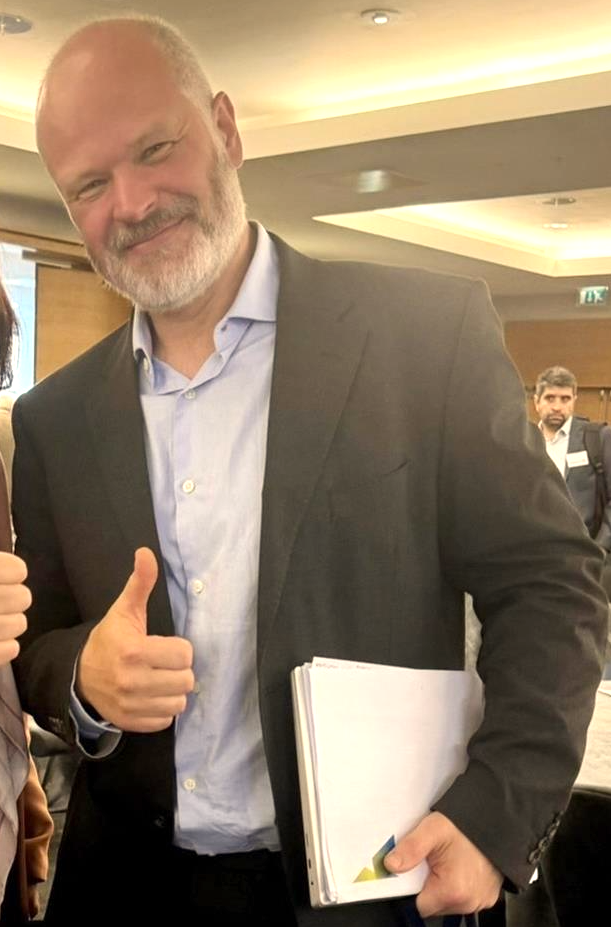
Pedro Faria is an EFRAG secretariat member overseeing the simplification of the environmental standards of the CSRD. He is also a veteran of CDP and SBTi. He has seen the sustainability ecosystem take shape and witnessed the rise and fall of initiatives from close by.
I sat down with him for a "behind-the-scenes" look at how standards are really made. He explained that for him, this work has never been about the technicalities. It’s about a "theory of change". A belief that disclosure, when done right, can be a powerful lever for transforming the economy.
You’ve dedicated a huge part of your career to developing and implementing standards. What’s the core driver for you? What makes this work so compelling?
The purpose is to switch on a light in the companies that allows them to see some of the strategic challenges they face in relation to sustainability and act on them.
The role of transparency on sustainability is to highlight this tension between business-as-usual and sustainability, not to solve it. It's to illuminate this tension. In my view, it cannot be solved by order of any bureaucrat. It's going to be solved by a social movement. Businesses need to see it, feel it, and then act upon it.
All we are trying to do is find ways of illuminating that. It is not about the business of auditing and compliance. It cannot be, it’s about transforming businesses and the economy.
Given that goal of driving real, strategic transformation, what is your main focus at EFRAG right now?
My main responsibility is overseeing the simplification of the five environmental standards. I've been working at EFRAG for almost three years now. I did not work on the first set of standards, but I am now part of the team working to deliver simplified standards.
The feedback on the CSRD was clear: the high level of ambition was disconnected from the immediate pressures businesses were facing.
Why is this "simplification" needed? What happened with the first, more ambitious set of standards?
The first set of standards was drafted during a period of immense political momentum. There was a powerful "spirit of the moment" driven by the Commission and the Green Deal, which led to a high level of ambition. I was at CDP at the time, and looking at the first ESRS draft, I thought, “Woah. This is highly ambitious. I wonder if it will be adopted.”
It was adopted. But then, as the political climate began to change, the pressure on and from companies changed, too. That very progressive draft met the reality of a different economic environment, and it 'bounced back.' The feedback was clear that the high level of ambition was disconnected from the immediate pressures businesses were facing.
C-level executives are accountable for the financial bottom line, ensuring operational resilience, [...] and justifying the cost and burden of new regulation.
What fascinates me: sustainability conferences are full of people who love the CSRD and are frustrated by the simplification. So who actually pushed back so hard?
You need to distinguish who you are talking to. One thing is if you talk to the CFO or CEO. Another is if you talk with the sustainability team. What you see on stage at a conference is usually the sustainability team, but the people that don't like CSRD are the ones that have power in the companies. The sustainability teams understand what we do, and they often support us. But now, we are getting a lot more messages that come from the C-level executives. They are accountable for a different set of pressures: the financial bottom line, ensuring operational resilience, justifying the cost and burden of new regulation, managing sensitive data and maintaining a competitive edge.
So you’re caught in this difficult position between the C-Suite and the NGOs. How do you navigate that?
People think it’s about the technicalities. But the devil is often in the details of the political consensus. If you are in the right spot, you must accept that not everyone will be pleased. You have the NGOs thinking you haven't gone far enough, and you have the companies thinking you have gone too far. If you have a fair consensus where both sides say, "I don't like this, but I can live with it," you are probably achieving what is possible at the moment.
If you go too far, you get what we see now: business pushes back and no movement is made at all, you have the risk of taking steps back. If standards are too weak, they are not taken seriously, NGOs and civil society will not support them and it will be detrimental to their adoption and use in the market place.
We have to constantly ask, "If we ask for this piece of information, what is it that we want to catalyze in terms of change?"
What have you learned about striking that balance?
The most important lesson is to be very clear about the 'theory of change.' We have to constantly ask, "If we ask for this piece of information, what is it that we want to catalyze in terms of change?"
It also means you have to understand what people really want. They will say, "I want this, I want that disclosure." But often, that’s not what they truly want. There is an underlying reason that they are not articulating. You need to get to that reason and understand what they truly want, or you’ll end up just adding to the requests for information and the bureaucracy.
Can you give a concrete example of this "playbook" in action? Where are you trying to find that balance right now?
Take the biodiversity metrics as an example. On one side, you have NGOs saying you must specify the biodiversity metrics. At least one for each of the drivers of biodiversity loss. They feel we haven't gone far enough.
On the other side, you have companies who warn that a "one-size-fits-all" metric will be an unworkable compliance burden that doesn't drive real change. They feel we are going too far. This is a current balancing act we are working on.
That's interesting. It reminds me of a concept Gavin Edwards of the Nature Positive Initiative shared. He argued that the ecosystem must agree on a common goal, but allow the how (the tools and methods) to be flexible and evolve. Does that resonate with your approach?
Yes. In this situation, it's better not to prescribe metrics directly in the standard. It’s better to put those specific metrics in guidelines that we can change at any time to reflect business practice, rather than locking them into the standard itself – at this moment.
Why? Because regulation needs to have a certain stability. If you put "land use change" in the standard as the metric, companies in, for example, Germany may say "This is not meaningful for me." But then the auditors may be strict and require it to be reported. This could drive political pressure to abandon the biodiversity standard because it's too difficult or irrelevant. Without consensus on the metric’s necessity, critics could easily dismiss it as an unnecessary burden on companies – and that’s exactly what you want to avoid.
So it’s better to avoid premature prescription of metrics, as much as possible, whilst making a reporting framework that brings transparency into what businesses are doing. In this case, the second best alternative to allow for flexibility in which metric to report – you shall report metrics, but up to businesses which metric to report. We get to learn what works and in the future, maybe we can be more prescriptive.
You're working under intense timelines. What is the consequence of that speed on this process?
The pressure of speed means you sometimes have to move forward knowing that what you are asking still contains gaps. You don't have the time or the mandate to develop all the methodologies for every single point or think things through all the way to the end, together with your wide range of stakeholders. You have to take some risks, knowing that what you are asking may not be perfect but, hopefully, is meaningful and will allow us to go in the right direction.
Speaking of direction. There’s quite some geopolitical shifts going on. Where do you see environmental reporting in the next five years?
The geopolitical situation is unstable and highly uncertain. What I want as a priority is that the idea of sustainability reporting gets consolidated with the biggest possible audience. That companies get used to reporting on carbon and nature from a regulatory perspective.
Maybe not at the highest standards, but at least consistently. Over time, that will yield a stable core of EU companies that understand how to think about their key strategic issues on sustainability. From there we can improve and innovate, incrementally, but steadily.
It’s relatively easy for a company to say they will reduce emissions by 50%. It’s a whole different game to show a valid transition plan that shows how they are making it happen.
Finally, we see companies set ambitious targets, but real-world emissions keep growing. How do you design a standard that measures actual progress and not just pledges?
Your concern is well-founded. So much work has been done on targets. We created the Science Based Targets initiative (SBTi), and now we have loads of commitments. But has there been real change? I hope so, but we cannot see it in the aggregated emission figures that continue to go up.
This is why I’m a big fan of the ACT (Assessing Low Carbon Transition) framework, that was launched at the same time as the SBTi. It was designed to be a systematic set of metrics to measure what companies were actually doing. Taking into account their past performance, current actions, and forward-looking strategy. The idea of "transition plans" emerged from that work. It’s a tool that illuminates the tensions inside a company that we discussed earlier in this conversation. It’s relatively easy for a company to say they will reduce emissions by 50%. It is quite different – materially different, to use ESRS terminology - to come up with a valid transition plan that shows how they are strategically making it happen. That is how we turn transparency from a compliance burden into a true engine for transformation.
We use cookies to improve your experience on our site and to understand where our audience is coming from. To find out more, please read our Privacy Policy. By choosing I Accept, you consent to our use of cookies.